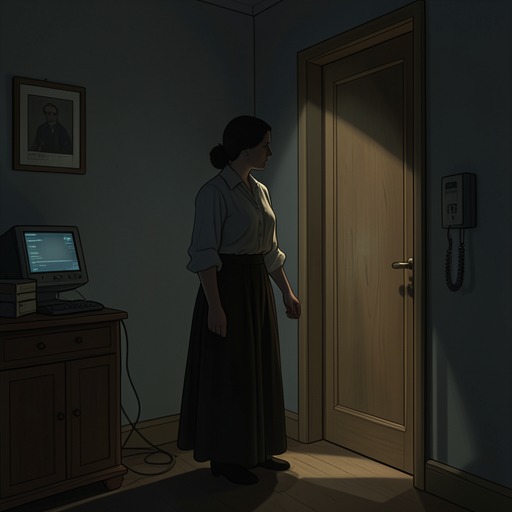
Seeking Justice Through Revenge
The HousemaidSeeking Justice Through Revenge is the novel’s morally unstable alternative to justice through official channels. Nina Winchester’s plan recruits Millie Calloway to kill Andrew Winchester, while Millie’s eventual response makes the attic’s logic of confinement and punishment rebound on him. Yet revenge does not simply repair the harm: Nina admits she could not take Andrew’s life herself, Millie faces the prospect of prison, and Nina must decide whether to expose her or shield her. The concept gathers together the novel’s questions about who is believed, who can act without being punished, and whether retribution can protect anyone without drawing others into its cost.
Unequal access to belief
Nina’s desire for an alternative to legal recourse develops in a world where her account of Andrew’s abuse can be dismissed as a symptom. She spends eight months at Clearview Psychiatric Hospital after being told she attempted to kill herself and Cecelia Winchester. Nina remembers none of the alleged attempt except waking to find Cecelia in the bathtub. Her therapist attributes her memories of confinement in the attic to delusions and the alleged attempt to depression; Nina is medicated and encouraged to accept a version of events she cannot remember. The gap between her vivid memory of the attic and the diagnosis placed over it makes the question of justice inseparable from the question of whose account counts as evidence.
That pattern recurs when Nina confides in Suzanne. After Nina tells her friend everything and asks for help going to the police, Suzanne secretly contacts Andrew, believing Nina is delusional. Andrew is waiting when Nina returns home, and she spends another two months at Clearview. Nina later forgives Suzanne, who apologizes, but the friendship is never the same and Nina says she can no longer trust anyone. The episode shows how Andrew can turn Nina’s psychiatric history into a means of isolating her: even a disclosure made in search of help becomes information that returns her to his control. His family’s influence also shadows the institutional account; during Nina’s later stay, she discovers that a Clearview director was a golfing companion of Andrew’s father.
Revenge as an escape plan
Nina’s plan changes in meaning as her circumstances become clearer. At first, she hopes a maid might become her replacement: if Andrew fell in love with another woman, he might let Nina go. But Millie’s appointment is not merely an effort to engineer a new relationship. Nina gives her a copy of the attic-room key and leaves pepper spray in a blue bucket in the closet; she eventually acknowledges that she hired Millie to kill Andrew, without telling Millie that this was the purpose. The objects make the plan concrete. A key offers access to the room where Nina has been confined, while the pepper spray equips Millie to confront the man who controls it.
That shift from replacement to intended killing marks the limit of Nina’s hope that Andrew will voluntarily release her. Revenge becomes a substitute for an escape route she cannot secure openly. But Nina’s strategy transfers danger rather than removing it. Millie is the person expected to act, and Nina’s concealed purpose leaves her unaware that she has been placed inside a lethal plan. The design promises Nina freedom while making Millie bear the immediate risk of violence and its legal consequences.
The attic’s punishment turned back
When Andrew screams after Millie sprays him in the eyes, his phone falls to the floor. Millie picks it up carefully; she has planned the next twenty seconds for more than six hours while three books rested on her belly. The contrast between extended preparation and the short window for action stresses how much depends on precise execution. Millie does not simply escape Andrew’s control: she uses a prepared opportunity to take control of the room and of what happens next.
Millie then makes release conditional on punishment. She orders Andrew to lie on the floor and put three books on top of himself, refusing to let him out until he complies. Her reference to having beaten a man to death with a paperweight underscores that Andrew misjudges what she is capable of, though she does not tell him about it. The books and the locked room turn punishment into a deliberate reversal: Andrew is made to experience confinement and imposed rules in the space where he exercised power over Millie. Nina’s plan has opened the possibility of retaliation, but Millie’s own history and choices shape what that retaliation becomes.
Consequences and responsibility
After Andrew dies, Millie understands the danger to herself. She tells Nina that she killed him by leaving him locked in the room for a week and fears she will spend the rest of her life in prison. Nina responds by deciding to protect her. Asked why she did not kill Andrew herself, Nina admits that fear of being caught, going to jail, and leaving Cecelia without her were part of the reason. But her answer goes further: she could not take his life, and she recognizes that she tried to trick Millie into doing it. The admission prevents Nina’s plan from reading as uncomplicated heroism. Her desire to escape Andrew coexists with her willingness to make another woman carry out the act she could not undertake.
Nina’s protection of Millie becomes another effort to manage how the death will be understood. She tells Detective Connors that Andrew must have been locked in the attic accidentally and that she thought he was away on a business trip. Connors points to the lack of calls or messages between them and to Andrew’s recent request that Nina move out. He also discloses that he had wondered what Andrew did to his daughter, and that the Winchesters once had influence among local police. His suggestion that the attic is a hazard offers Nina a way to sustain the accidental-death account without dragging Millie into it. The exchange reveals a quiet counterweight to institutional power: Connors does not demand a full confession, and Nina’s protection of Millie meets a willingness to let the story stand.
Punishment, inheritance, and moral ambiguity
At Andrew’s funeral, Nina keeps Millie’s involvement secret. Evelyn Winchester, looking at her dead son, recalls enforcing a rule that Andrew brush his teeth every night and punishing him when he did not. She says she once pulled out one of his baby teeth with pliers, then tells Nina she is glad she taught him a lesson. Her approval links Andrew’s death to an older pattern in which punishment is presented as a response to broken rules. It also complicates Nina’s secrecy: Evelyn’s words suggest that at least one person in Andrew’s family recognizes the violence done to him, even as the full circumstances remain concealed.
The novel therefore treats revenge as both a response to failed protection and a dangerous imitation of the coercive order it opposes. Andrew’s abuse is not made harmless by Nina’s plan, nor is his death shown as a clean legal resolution. Instead, the attic’s punishments return against him, Millie faces the consequences of carrying them out, and Nina tries to prevent that consequence from consuming another life. Justice, in this account, is pursued through private action and partial truth; its immediate promise of freedom remains entangled with manipulation, fear, and the choice to protect one another.